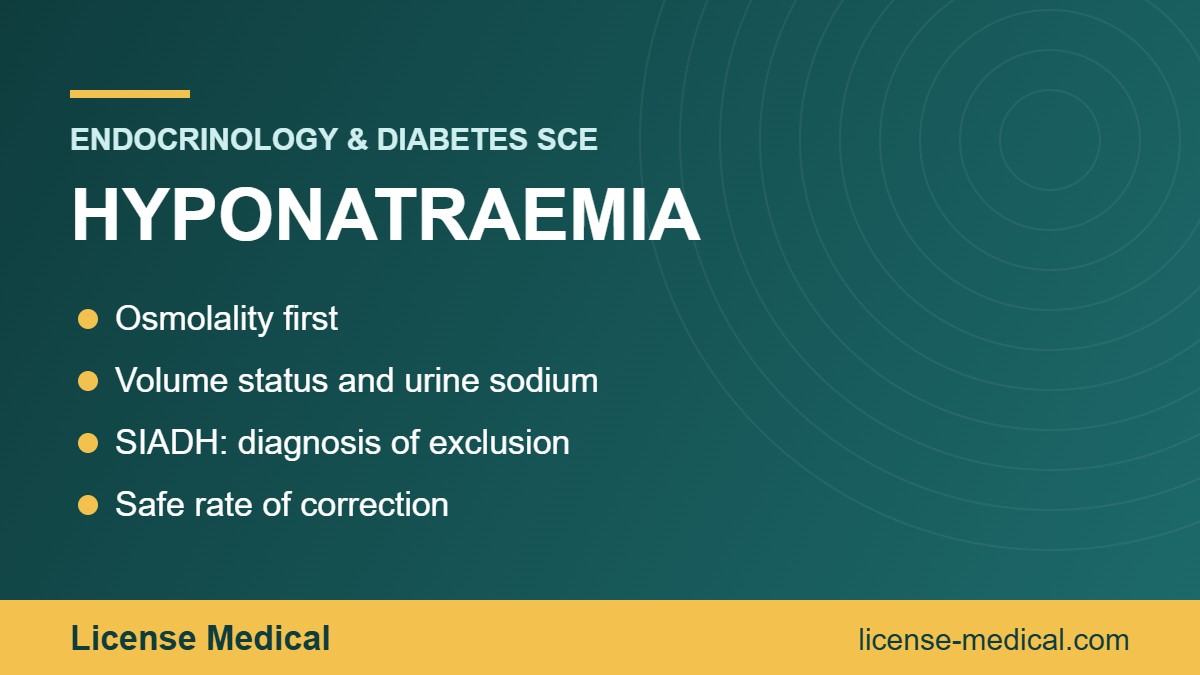
A favourite exam topic
Hyponatraemia is the most common electrolyte disorder in hospital practice and a favourite topic in the Endocrinology and Diabetes SCE. Questions reward a structured approach. If you follow the same steps every time, most stems become straightforward.
Step 1: check serum osmolality
First confirm that the patient has true hypotonic hyponatraemia. A normal or high serum osmolality suggests pseudohyponatraemia, for example from severe hyperlipidaemia or paraproteinaemia, or the presence of another osmotically active substance such as glucose. In hyperglycaemia, sodium falls as water shifts out of cells, so correct for the glucose before going further.
Step 2: assess urine osmolality and urine sodium
A very low urine osmolality points to excess water intake, such as primary polydipsia or low solute intake. If the urine is concentrated, the urine sodium helps to separate causes. A low urine sodium suggests low effective circulating volume, for example from gastrointestinal losses, heart failure or cirrhosis. A high urine sodium suggests renal sodium loss from diuretics or adrenal insufficiency, or a euvolaemic state such as SIADH.
Step 3: assess volume status
Clinical assessment of volume status is difficult but important. Hypovolaemic patients with renal sodium loss may be taking thiazides, which are a very common cause of hyponatraemia in older people. Hypervolaemic patients have oedema from heart, liver or kidney disease. Euvolaemic patients raise the possibility of SIADH, hypothyroidism or glucocorticoid deficiency.
SIADH is a diagnosis of exclusion
Before diagnosing SIADH, exclude hypothyroidism, adrenal insufficiency and diuretic use. Typical findings are low serum osmolality, inappropriately concentrated urine, a urine sodium usually above 30 mmol/L and clinical euvolaemia. Causes include drugs such as SSRIs, carbamazepine and other agents, lung and central nervous system disease, malignancy, pain, nausea and the postoperative state. Missing adrenal insufficiency is a classic exam trap, and it is dangerous in real practice.
Treatment and safe correction
Severe symptoms such as seizures, reduced consciousness or vomiting need urgent treatment with hypertonic saline, given as boluses according to current guidance, with close monitoring of sodium. In all patients, avoid correcting sodium too quickly. European guidance advises limiting the rise to 10 mmol/L in the first 24 hours, with a lower target in patients at high risk of osmotic demyelination, such as those with alcohol misuse, malnutrition or hypokalaemia. For chronic SIADH, fluid restriction is first-line, and specialist options include drugs that target the vasopressin pathway in selected patients.
Exam tips
Work through osmolality, urine tests and volume status in order. Check whether a culprit drug was recently started, and always ask whether adrenal insufficiency or hypothyroidism has been excluded before accepting a diagnosis of SIADH.
Practise with License Medical
The License Medical Endocrinology and Diabetes question bank includes exam-style Best of Five questions on this topic and across the curriculum, each with a guideline-based explanation. Start revising at license-medical.com/question-bank-details/endocrinology-and-diabetes/.
Source: Spasovski G, et al. Clinical practice guideline on diagnosis and treatment of hyponatraemia. European Journal of Endocrinology, 2014.