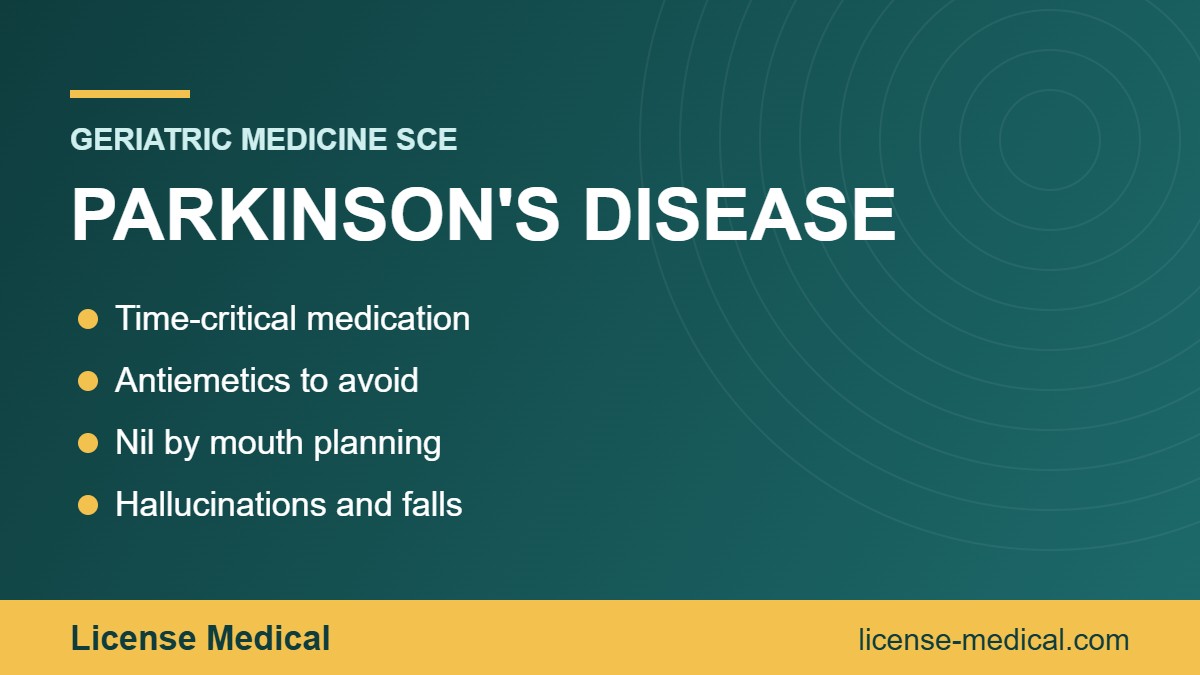
Why Parkinson's disease is high yield
Parkinson's disease dominates the neurology content of the Geriatric Medicine SCE. Most questions are not about diagnosis. They test the practical decisions a geriatrician makes when a person with Parkinson's is admitted to hospital, becomes unwell, cannot swallow or develops hallucinations. These are areas where mistakes cause real harm, which is exactly why the exam focuses on them.
Time-critical medication
Parkinson's medicines are time critical. Parkinson's UK recommends that people in hospital receive their medication within 30 minutes of their usual time. Missed or delayed doses can lead to rapid loss of mobility, swallowing difficulty, falls, aspiration and, rarely, a life-threatening reaction resembling neuroleptic malignant syndrome. In an exam question, any delay in giving levodopa after admission should prompt you to restore the usual regimen as a priority.
When the patient is nil by mouth
If a patient cannot take medicines by mouth, do not simply omit them. Options include giving levodopa through a nasogastric tube if one is in place, or converting the patient's regimen to a transdermal rotigotine patch using a recognised conversion calculator, with advice from the Parkinson's team or pharmacist. Questions often describe a patient made nil by mouth before surgery or after a stroke, and the correct answer is the option that keeps dopaminergic treatment going.
Antiemetics and antipsychotics to avoid
Dopamine antagonists can severely worsen parkinsonism. Avoid metoclopramide, prochlorperazine and typical antipsychotics such as haloperidol. Domperidone does not cross the blood brain barrier easily and is often preferred, although its cardiac risks mean the dose and duration should be limited. Ondansetron is another option for nausea, but it must not be combined with apomorphine because of the risk of severe hypotension.
Hallucinations and psychosis
Visual hallucinations are common in Parkinson's disease, particularly in older people and those with cognitive impairment. First look for a trigger such as infection, dehydration or a recently added medicine, and consider reducing drugs most likely to cause hallucinations, such as anticholinergics, amantadine and dopamine agonists, before reducing levodopa. If treatment is needed, NICE guideline NG71 supports quetiapine, or clozapine with appropriate blood monitoring, while typical antipsychotics should be avoided. The same caution applies in dementia with Lewy bodies, where antipsychotic sensitivity can be severe.
Falls, orthostatic hypotension and swallowing
People with Parkinson's disease fall frequently because of postural instability, freezing, orthostatic hypotension and medication effects. Orthostatic hypotension may be worsened by levodopa and dopamine agonists as well as by antihypertensives, so medication review is central. Swallowing difficulty increases the risk of aspiration pneumonia and should prompt speech and language therapy assessment.
Exam tips
When a stem mentions Parkinson's disease, check three things: whether the patient is getting their medication on time, whether any newly prescribed drug blocks dopamine, and whether the presentation could be explained by a missed dose or an intercurrent illness. These checks will point you to the answer in a large proportion of questions.
Practise with License Medical
The License Medical Geriatric Medicine question bank covers Parkinson's disease, movement disorders and their complications with exam-style Best of Five questions and guideline-based explanations. Try a free test at license-medical.com/question-bank-details/geriatric/.
Sources: NICE guideline NG71, Parkinson's disease in adults; Parkinson's UK guidance on time-critical medication.